Monday, March 20, 2023
SUpreme CourT cases could RESHAPE Navajo Nation WATER RIGHTS (online article) interview
FROM N P R
Supreme Court cases could reshape Navajo Nation water rights
March 19, 20235:43 PM ET
Heard on All Things Considered
HEAR STORY/ READ STORY online from N P R
PIEN HUANG, HOST:
Tomorrow, the Supreme Court will hear arguments in a case involving water rights for the Navajo Nation. The issue at hand is, what does the federal government owe to tribal nations when it comes to water and access to it for drinking and growing food? It's a pretty complex set of issues that go way back in time and could change things for the Navajo Nation going forward. We've called Gregory Ablavsky to help break things down. He's a professor at Stanford Law School, where he teaches courses on federal Indian law. Greg, welcome. Thanks for joining us.
GREGORY ABLAVSKY: Thank you for having me.
HUANG: So, Greg, the Supreme Court tomorrow is hearing a case related to water needs in the Navajo Nation. Help us understand what is at issue in this case.
ABLAVSKY: When the federal government establishes a reservation for Native peoples, the law has been since 1908 that it also then implicitly sets aside water rights for the purposes of providing agriculture and supporting the people who are going to be living on that reservation. Twenty years ago, the Navajo Nation sued the federal government as the nation's trustee, arguing that the federal government had a trust obligation to provide water to the Navajo Nation from the main stem of the Colorado River that flows, actually, right next to the reservation. So the question in this case is whether the federal government, as the trustee, is in fact obligated - it has a judicially enforceable trust obligation to provide that water, to figure out how much water is actually owed to the Navajo Nation from the Colorado River.
HUANG: Can you also just explain quickly what a trust obligation actually means? It sounds like one of these legal terms that, you know, I certainly haven't heard a lot before.
ABLAVSKY: If we think about ordinary trust law, someone might create a trust, you know, let's say, for their grandchildren or their children. Or if you just have an ordinary trust, there is a trustee who manages the benefits for a beneficiary. So, you know, in this case, the beneficiary would be the grandchildren. And there's a whole body of law - of trust law - that applies in those circumstances. Here, the argument is, is the federal government in this same - has it established this trust with respect to the Navajo Nation and other Native peoples? In other words, is the federal government the trustee and the Navajo Nation the beneficiary, such that ordinary trust law principles can be applied? So, ordinarily, a beneficiary can sue a trustee for accounting or for mismanaging the trust corpus, as it's called - the body of the trust, which in this case would be water. And so the question is, do those ordinary principles of trust law apply in this case as well?
HUANG: And, Greg, what is the water situation on the Navajo Nation right now? You know, is the argument from the Navajo Nation that they just don't have enough of it?
ABLAVSKY: I mean, the water situation on the Navajo Nation is pretty bleak. A very high percentage - almost a third, I think - of Navajo homes lack running water. And this was a major factor that contributed to the extreme outbreak of COVID that they experienced there. So the Nation argues pretty forcefully that the water situation there is extreme. And, of course, as we've all been seeing, the entire Southwest is going through a dramatic drought. Water levels in the Colorado River have dropped pretty dramatically. And so the Nation, I think, is - I mean, they initiated this lawsuit a long time ago, but the Nation has long been concerned in making sure that its citizens have access to reliable, clean, safe water. And that hasn't yet happened, in large part because of sort of resource constraints.
HUANG: So as you mentioned, this particular case focuses on getting access to water from the Colorado River in a time of drought. You know, water levels are dropping in the rivers, you said. So help us understand, what are the arguments on each side of the case?
ABLAVSKY: So the argument that the Navajo Nation is advancing is that because of this decision from 1908 called Winters, saying that the federal government implicitly reserves water rights, that decision created a trust obligation on the part of the federal government that can be enforced in court. The argument on the other side that the federal government is making, as well as several states that have intervened, is actually that that decision is not enough to actually create a judicially enforceable trust obligation.
HUANG: Before we let you go, we know that oral arguments are going to take place tomorrow, so what are you going to be paying attention to as the case is argued?
ABLAVSKY: I mean, I think what I'll be looking for in tomorrow's arguments is to see how the justices are understanding this relationship between the federal government and Native nations and whether they think this 1908 decision, coupled with the treaties of the Navajo Nation, is enough to create that judicially enforceable trust obligation. It'll be interesting also to see how much they dive into some of the technicalities of water law and of trust law in this instance and how much they're concerned about sort of the broader question of the difficult water situation that confronts the U.S. West right now.
HUANG: That was Professor Gregory Ablavsky from Stanford Law School. Professor Ablavsky, thank you.
ABLAVSKY: Thank you very much.
Copyright © 2023 NPR. All rights reserved. Visit our website terms of use and permissions pages at www.npr.org for further information.
NPR transcripts are created on a rush deadline by an NPR contractor. This text may not be in its final form and may be updated or revised in the future. Accuracy and availability may vary. The authoritative record of NPR’s programming is the audio record.

Tuesday, February 28, 2023
Wet, Anthology of Water Poems and Prose from the High Desert and Mountains of the Four Corners Region

Thursday, February 16, 2023

Southwest Matriarchy, Cultural Migrations at Aztec Ruins National Monument

Monday, November 28, 2022
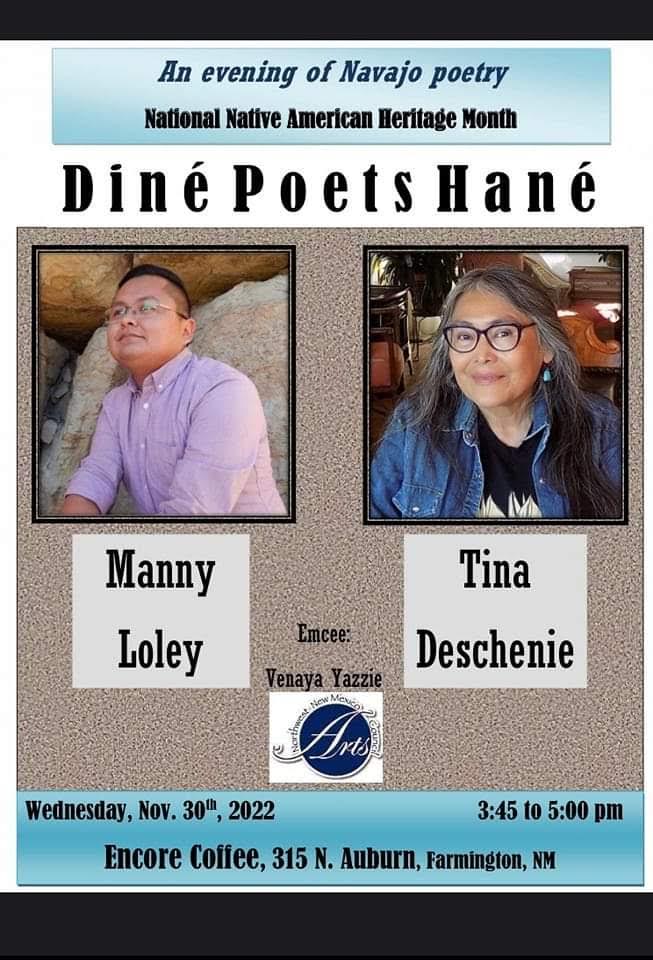
Diné (Navajo) poetry is Identity
Thursday, October 20, 2022
Adorned in the Southwest
Trekking the lands of the Dine' and the Hopi people in northwest Arizona is a blessing.


Thursday, August 25, 2022
Aak'ee...... Dine' Navajo season of gratitude

Subscribe to:
Posts (Atom)