Monday, April 23, 2018

Diné Women Poets & National Poetry Month


Official Poster Announcement from Cortez Public Library 2018

On Friday, April 20, 2018 five Dine' women poets from the Four Corners communities of New Mexico, Colorado, Arizona and Utah converged at the Cortez Public Library in southwestern Colorado to celebrate National Poetry Month. The event was coordinated by Librarian Kathy Berg and her staff.  The event poster announcement I posted contains information about the event and sponsors.  I share this information on my blog as a means of celebrating the Arts in the Four Corners community.

Invited Dine' (Navajo) poetess' included:

Tacey Atsitty (Navajo)
Esther Belin (Navajo)
Tina Deschenie (Dine'/ Hopi)
Gloria Emerson (Navajo)
Venaya Yazzie (Dine'/Hopi)

Although I was late in arrival to the event, I was able to enjoy the poetry reading shares of Gloria Emerson and Tina Deschenie.  As a poet in the high desert southwest I feel so very blessed and humbled to have been given the opportunity to read along side these empowered desert matriarchs. I have included a photo capture of all of us after the event.

Navajo poets: (L to R)
Venaya Yazzie, Tina Deschenie, Esther Belin, Gloria Emerson, Tacey Atsity

Please support the Indigenous poets of North America, Canada, Mexico and South America, there is a plethora of diverse voices in all communities.  The real narratives of each Dine' women was heard that night as we all share our experiences in the 21st century as tribal members and also as women in the Arts and writing communities.  The matriarch elder of the group was artist and poet Gloria Emerson who is such a blessing to all of us as she stands steadfast as a leader in her community.

If you would like more information on the above listed poets just 'google' their names and I'm sure you will find out much. But, I will include a link from the Cortez Journal for more information.


Many Blessings.

(posted 4-23-18 by Venaya Yazzie)
ALL RIGHTS RESERVED


Wednesday, April 18, 2018

Collaboration with Arizona Photographer Amy S. Martin & Yazzgrl Art


Women Protectors - Photo series by Amy S. Martin and Venaya Yazzie 2018


Capture from Instagram account of Yazzgrl Art - Venaya Yazzie

This year has been a blessing for me.  My path has crossed with a high desert Colorado Plateau fine art Photographer, Amy S. Martin.  We have collaborated via our imagery and design in this new project titled "Voices of the Colorado Plateau" which includes portraits of Indigenous women of the Navajo Nation and Eastern Dine' Nation in which I am a representative.  I have included a capture of my Instagram art account Yazzgrl.Art to display one image done by Martin.

It was as such a blessing to work with Amy when she visited New Mexico last month.  I was able to share my family's cultural history of our homelands and our unique cultural landscape.  This image was taken at the family lands at Dzilthnaodithle (Huerfano, NM).

The image of of  me dressed and adorned in my family-made Dine' cultural women's attire, a wool dress called a 'biil' was taken by Amy on her visit. The art image in the background is my artwork which consists of a New Mexico Bluebird, or in the Dine' language this being is referred to as "Dolii."

I include this artist description by Amy S. Martin from her website (http://www.amysmartinphotography.com/p159598639)


Diverging from traditional environmentalist thought, I believe landscape is a synthesis of elements inextricably linked to the physical land, encompassing ecology, history and culture. Through a collection of collaborative portraits, this series celebrates Indigenous women on the Colorado Plateau who are advocating for protection of their culture, communities, and endangered lands through their actions, words and art. These portraits honor kinship with the land, reveal what is at stake if these landscapes and cultures are lost, and celebrate the strength of the women who are on the frontlines of their protection.


My hope in sharing is  that you will be blessed and inspired by the efforts of Amy and also myself as a contributor.

Blessings,
VJY


Sodizin everytime.


Art design by Venaya Yazzie
ALL RIGHTS RESERVED 2018


Prayer.

This expression of the human in most Indigenous societies is essential for a 'good life.'

Via American social trends and cultural 'norms', prayer has become absent in the lives of most people, including the 21st century Indigenous person. For the Dine' person "sodizin" is the expression of thankfulness and happiness and balance for our lives.

The state of prayer in the lives of southwestern tribal individuals is how many of us keep our daily senses. Creator has given us the ability to pray as a means of 'humbling' ourselves.  We must NOT forget this essential part of our culture Indigenous people! Decolonize your mind, your ways from non-Indigenous pop culture. We are a complex mix of unique and sacred beings, don't homogenize yourself.

Be Indigenous!
Be Matriarch!
Be and do prayer.

Blessings All Around you.

VJY
04-18-18


Wednesday, March 14, 2018

Asdzaa doo Hastiin


Historical photo of Navajo man and woman
Source: World Wide Web

The roles we exist as in the Dine' (Navajo) ways of life, of being are so very important.

This innate assignment was given to use on the day of our birth. We were either made to be a male or female via our physical, mental and emotional state. The distinct roles as distinct genders in Navajo culture is like an act of sacred prayer. Existence of either the male or the female  concerns not only to our identity as Dine' people, as asdzaa, woman or as hastiin, man, but also to the specific roles we inhabit in our cultural ways.  To be sure, the 21st century has plagued our Dine' ways of being with many social ills, and new foreign practices of living and thinking which concerns American assimilation. Though there are a plethora of examples, present (Euro American) society which includes philosophers and educators, are stating that gender does not exist or does not matter. This is blasphemy against Indigenous epistemology, our Indigenous knowledge is who we are, it is our truth.  Our communal knowledge of male and female is how we were divinely made by Creator God. He made us distinct in our genders, for the Dine' it is asdzaa and hastiin.

We as unique genders 'balance' ourselves out, we compliment one another and that is an extension of what we as Dine' express as "hozho." Here in the desert southwest, gender roles are held to the highest esteem by many tribal members, such roles are necessary and relevant in keeping our ceremonial and social activities in tact and pure.

We as Indigenous need to hold on steadfast to our ancestral ways of being and stop being fooled by the trends of Euro-American society. This conscious way of living as an Indigenous person in modern urban life is what is expressed as "decolonizing."

Bless each other by speaking the truth of who we are as Indigenous, we are not "Them" - we are sacred Indigenous.

In a good way.


Friday, March 2, 2018

SW Indigenous Women's Power in 2018


Pueblo women in traditional
women's garments
Photo sources: World Wide Web


I really adore this historic photo. Its a simple portrait of a southwestern woman dressed in her best Pueblo-style women's garments. She stands in her stillness so beautiful and powerful.

As a southwestern Indigenous woman I know the feeling of this 'power' she holds, for I too know it as I often wear my cultural garments. Its a way of being that really cannot be described, but only to say I feel like a time-traveler in my desert moccasins and women garments and of course, turquoise!

In this image the ancestor femme wears a Pueblo-style woven dress, manta wrap, white deer skin moccasins and leg wraps and a silver bead and naja necklace adornment.  I assume it may be a Navajo-made necklace because at this point in history, Navajoland hosted a plethora of silversmiths.  And one characteristic of early Navajo silver jewelry, such as this squash blossom type, was made with not turquoise, just pure silver. I also love this image for the fact that the women seems to be very unique in her look. She seems to be very light-skinned and has light-colored hair in this photo, so as an observer I believe she may be albino.  I have met many Pueblo people from New Mexico and Arizona who are albino.  I many cause these people are revered and honored for their difference in phenotype.

In the chaos of the 21st century it is a relief to know I have a 'power' in my cultural ways of being, as I can still honor my southwest ancestors, my desert matriarchs and adorn myself in these ancient traditions. Its a way of being a 'warrior woman' - knowing this grand history of them is my super power indeed!

Blessings all around.
Posted March 2, 2018
by Venaya Yazzie
ALL RIGHTS RESERVED 2018


Wednesday, February 14, 2018

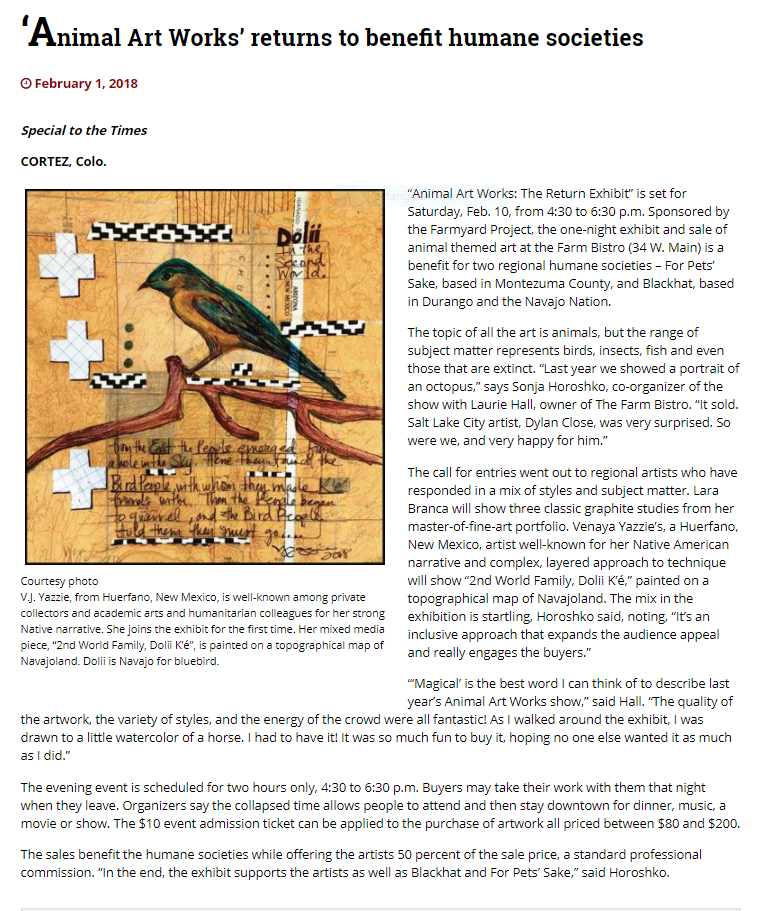
Navajo Times article by Sonja Horoshko on my artwork in group show


February 1, 2018 screenshot of  Navajo Times article on my artwork.
Story authored by Sonja Horoshko, Cortez area Journalist.


As an Indigenous artist, as a woman artist I am very cognizant of the of the dialogue produced by the art I am inspired to produce.

In observation of my current work(s) I realize who it concerns an audience outside the boundaries of Navajoland, in my opinion its a good thing, but also a large responsibility. In being an artist all my life, but a professional practicing artist I believe that I've matured as a poet, as a visual artist so now I understand the necessity of my one voice to the greater narrative.

The decision to work in with the voice of my activist self is a blessing, from this decision I have been able to be active in the dialog of not only the uranium issue, but also Desert Rock, the Gold King Mine Spill, Chaco Canyon fracking and currently Bears Ears.... these are all issues that have reached all areas of Navajoland.

I share this with you because 'place' and the natural world are essential for me as an artist.  The land is my muse. For the Navajo, the Pueblo and other southwest high desert tribal people, the story of the land is shared, but specific areas and sacred sites have a complex narrative behind them and therefore are so important in my art created, these are the stories of 'Nahasaan Shima', Mother Earth.

The people, the land, the animals and sky all intrigue and inspire me greatly.

Blessings in All things.


Tuesday, January 30, 2018

This is my power, my strength


Matriarch's power  regalia
                                  by Venaya Yazzie
                          ALL RIGHTS RESERVED 2018

From time immemorial my Indigenous people, the tribal relatives from across 'Indin' Country has trekked the beloved spaces of their cultural homelands.

The land is in our blood, the DNA we carry as Indigenous people is as sacred as many of our ceremonies.  Today in 2018, we Indigenous are still here, we are still on our ancestral homelands via reservations and bordertown communities.  But, in today's climate we are have little peace.  The land we love is being ravaged and in some instances being out right taken from us.  This story is not new, for the establishment of this Euro-American government  was done under the act of theft.

Today I am an artist, I am an Indigenous artist that because of her ethnicity is labeled an "activist" simply because I make art about my life experiences. I am unconsciously political because I am a 21st century living Indigenous person.

I share this image above in this blog because I can exist in two worlds, two places in this place called America. Some days I wear Levis and Converse and on other days I am dressed to the 'nines' in my southwest matrillenial cultural regalia; this is my power, my strength.  I am a Dine' -Hopi woman, and I dwell in my culture and lands and language and among my people.  Then I exist in the chaos of modern society, when I want to that is...

I, like all my Indigenous people/relatives are stronger than how we are perceived by mainstream culture. We exist in two spaces one that is in the present, but also one that is unseen.  Believe it!


Posted 01-30-18
by Venaya Yazzie
ALL RIGHTS RESERVED 2018


Monday, January 29, 2018

Her hands 'in motion', working 'in Beauty.'


Masani's hands at woven sash belt
Photo credit: Venaya Yazzie
2018 ALL RIGHTS RESERVED
Lately, my mind has been immersed in the process of my Navajo people's cultural way of weaving rugs.  My late great matriarch Louise Begay Werito was an avid, master weaver, she was known for her "eye dazzler" designs - with that vivid red wool intermingled with the lighter hues of greys and black.  Growing up, we grandchildren were blessed to be in the immediate company of our maternal great grandparents at their home in Huerfano, NM in northwest New Mexico.

I remember the scene of their 'living' room area, the wood stove sitting in the north, and their vintage couches on either sides of the room.  The house door was set in the east.  This home is forever plaqued on my heart.  When I think of the great love that dwelled in the the reservation home of my great grandparents, I know I was safe.  Both my grandparents were forever busy with their hands. And it was taught that one must not be idle, or lazy, they instilled in us that we are human beings with ten fingers and hands that were capable of 'creating' things, 'beautyful' things.

Today as an adult, as an artist I hold both their teachings close to my spirit. The words and expressions that they shared with each of us grandchildren were sacred.  I understand and appreciate this now and it keeps me steadfast in my endeavors as a professional woman artist.

In 2018 my life is blessed too, I am daily in the company of my 87 year-old masani, my maternal grandmother, but she is is my 'mother' too. During my days with her I observe her, how she is constantly 'busy' with her hands.  The photo capture above is one I share as it illustrates her hands in motion, working 'in Beauty.' In this image she is making tassels for the pictured Navajo-made sash belt.  As she twists the wool yarn pieces she expresses how Navajos should "always finish their belts with the tassel work."  Its a task that asks the maker for great patience, but it too is a way to soothe the spirit in the process of twisting yarn and joining them together.

As Navajos in the new century I am very aware of how resilient we are. How we are generally steadfast in keeping our culture and language breathing and alive.  This conscious act IS the 'Beautyway' ceremony of our ways of being.  We may not always be adorned and dressed in our regal tribal regalia and jewelry, but we are keeping our ancestral cultural ways 'alive!' no mater how small the task or conversation is.

Book of Navajo rugs
Photo credit: Venaya Yazzie
2018 ALL RIGHTS RESERVED
As she does her matriarch task, I sit on the other side of the kitchen table looking at a well-known publication about the tradition of Navajo weaving and historical rugs. The 'ol school' works of Navajo art is profound! We, our Navajo matriarchs were (and are) amazing artists.  Our work was conceptual before American culture even knew anything about art. Our Navajo art, via the Navajo-woven rugs, were beyond 'beautyful' - for the each told a story, the story of Us as Navajos, each piece carried and continue to carry the narrative of our strength, our life as Creator's children, our voices, songs and prayers...  I cannot fully explain the goodness of spirit I feel when I look at these rugs, but I know jsut by 'seeing' them I am being blessed by my ancestors.


Blessed
(posted 01-29-18)
Eastern Navajoland, NM USA