Wednesday, February 14, 2018

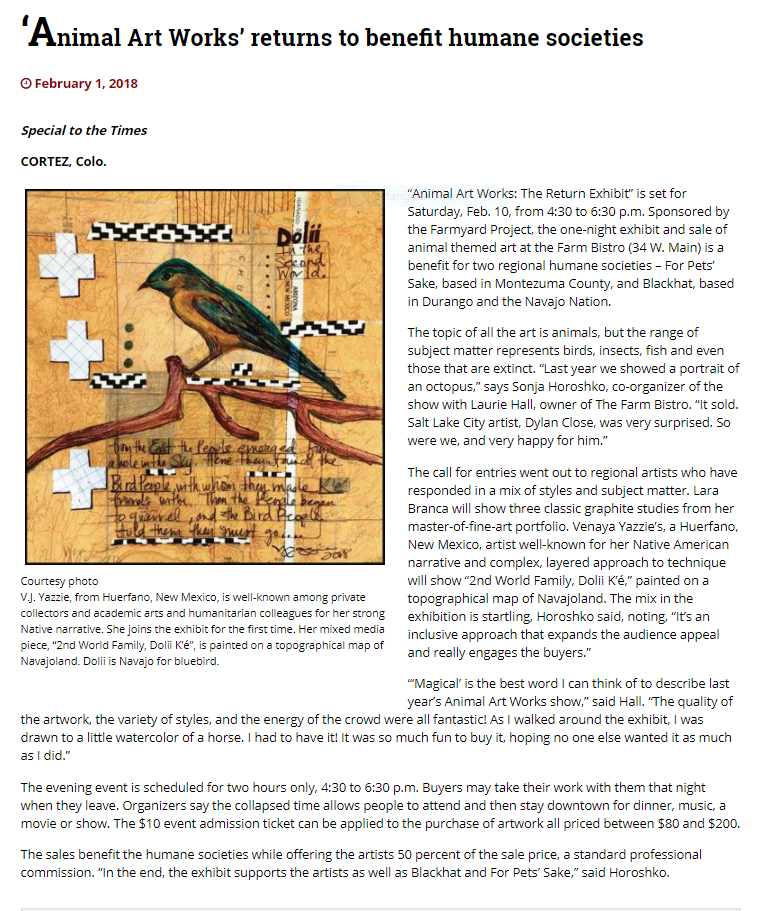
Navajo Times article by Sonja Horoshko on my artwork in group show


February 1, 2018 screenshot of  Navajo Times article on my artwork.
Story authored by Sonja Horoshko, Cortez area Journalist.


As an Indigenous artist, as a woman artist I am very cognizant of the of the dialogue produced by the art I am inspired to produce.

In observation of my current work(s) I realize who it concerns an audience outside the boundaries of Navajoland, in my opinion its a good thing, but also a large responsibility. In being an artist all my life, but a professional practicing artist I believe that I've matured as a poet, as a visual artist so now I understand the necessity of my one voice to the greater narrative.

The decision to work in with the voice of my activist self is a blessing, from this decision I have been able to be active in the dialog of not only the uranium issue, but also Desert Rock, the Gold King Mine Spill, Chaco Canyon fracking and currently Bears Ears.... these are all issues that have reached all areas of Navajoland.

I share this with you because 'place' and the natural world are essential for me as an artist.  The land is my muse. For the Navajo, the Pueblo and other southwest high desert tribal people, the story of the land is shared, but specific areas and sacred sites have a complex narrative behind them and therefore are so important in my art created, these are the stories of 'Nahasaan Shima', Mother Earth.

The people, the land, the animals and sky all intrigue and inspire me greatly.

Blessings in All things.


Tuesday, January 30, 2018

This is my power, my strength


Matriarch's power  regalia
                                  by Venaya Yazzie
                          ALL RIGHTS RESERVED 2018

From time immemorial my Indigenous people, the tribal relatives from across 'Indin' Country has trekked the beloved spaces of their cultural homelands.

The land is in our blood, the DNA we carry as Indigenous people is as sacred as many of our ceremonies.  Today in 2018, we Indigenous are still here, we are still on our ancestral homelands via reservations and bordertown communities.  But, in today's climate we are have little peace.  The land we love is being ravaged and in some instances being out right taken from us.  This story is not new, for the establishment of this Euro-American government  was done under the act of theft.

Today I am an artist, I am an Indigenous artist that because of her ethnicity is labeled an "activist" simply because I make art about my life experiences. I am unconsciously political because I am a 21st century living Indigenous person.

I share this image above in this blog because I can exist in two worlds, two places in this place called America. Some days I wear Levis and Converse and on other days I am dressed to the 'nines' in my southwest matrillenial cultural regalia; this is my power, my strength.  I am a Dine' -Hopi woman, and I dwell in my culture and lands and language and among my people.  Then I exist in the chaos of modern society, when I want to that is...

I, like all my Indigenous people/relatives are stronger than how we are perceived by mainstream culture. We exist in two spaces one that is in the present, but also one that is unseen.  Believe it!


Posted 01-30-18
by Venaya Yazzie
ALL RIGHTS RESERVED 2018


Monday, January 29, 2018

Her hands 'in motion', working 'in Beauty.'


Masani's hands at woven sash belt
Photo credit: Venaya Yazzie
2018 ALL RIGHTS RESERVED
Lately, my mind has been immersed in the process of my Navajo people's cultural way of weaving rugs.  My late great matriarch Louise Begay Werito was an avid, master weaver, she was known for her "eye dazzler" designs - with that vivid red wool intermingled with the lighter hues of greys and black.  Growing up, we grandchildren were blessed to be in the immediate company of our maternal great grandparents at their home in Huerfano, NM in northwest New Mexico.

I remember the scene of their 'living' room area, the wood stove sitting in the north, and their vintage couches on either sides of the room.  The house door was set in the east.  This home is forever plaqued on my heart.  When I think of the great love that dwelled in the the reservation home of my great grandparents, I know I was safe.  Both my grandparents were forever busy with their hands. And it was taught that one must not be idle, or lazy, they instilled in us that we are human beings with ten fingers and hands that were capable of 'creating' things, 'beautyful' things.

Today as an adult, as an artist I hold both their teachings close to my spirit. The words and expressions that they shared with each of us grandchildren were sacred.  I understand and appreciate this now and it keeps me steadfast in my endeavors as a professional woman artist.

In 2018 my life is blessed too, I am daily in the company of my 87 year-old masani, my maternal grandmother, but she is is my 'mother' too. During my days with her I observe her, how she is constantly 'busy' with her hands.  The photo capture above is one I share as it illustrates her hands in motion, working 'in Beauty.' In this image she is making tassels for the pictured Navajo-made sash belt.  As she twists the wool yarn pieces she expresses how Navajos should "always finish their belts with the tassel work."  Its a task that asks the maker for great patience, but it too is a way to soothe the spirit in the process of twisting yarn and joining them together.

As Navajos in the new century I am very aware of how resilient we are. How we are generally steadfast in keeping our culture and language breathing and alive.  This conscious act IS the 'Beautyway' ceremony of our ways of being.  We may not always be adorned and dressed in our regal tribal regalia and jewelry, but we are keeping our ancestral cultural ways 'alive!' no mater how small the task or conversation is.

Book of Navajo rugs
Photo credit: Venaya Yazzie
2018 ALL RIGHTS RESERVED
As she does her matriarch task, I sit on the other side of the kitchen table looking at a well-known publication about the tradition of Navajo weaving and historical rugs. The 'ol school' works of Navajo art is profound! We, our Navajo matriarchs were (and are) amazing artists.  Our work was conceptual before American culture even knew anything about art. Our Navajo art, via the Navajo-woven rugs, were beyond 'beautyful' - for the each told a story, the story of Us as Navajos, each piece carried and continue to carry the narrative of our strength, our life as Creator's children, our voices, songs and prayers...  I cannot fully explain the goodness of spirit I feel when I look at these rugs, but I know jsut by 'seeing' them I am being blessed by my ancestors.


Blessed
(posted 01-29-18)
Eastern Navajoland, NM USA


Sunday, January 21, 2018

Sunday Snow


Today I awoke to wind and cold, and as I looked outside the land was coated with snow. I felt so inspired and in that musing I brought out my beads and thread and needle. I am now amidst the creation of new Yazzgrl Art beaded earrings and other beading projects for some upcoming Indian Market shows this year.

I have my coffee in my favorite Pueblo-made mug and I am ready to enjoy my Sunday.

Indigenous Adornment is always in our sights, open your eyes to see it clearly in 2018!

Blessings
(posted 01-21-18)
Navajoland
New Mexico, USA


'Ya'at'eeh' -Navajo greetings & blessings


2018 amidst YazzGrl Art


Greetings in the new year of 2018!

The last part of the year last past went by fast for me - and this new month is fleeting also. I would like to say 'ya'at'eeh' (Navajo greeting blessing) to all of those who visit my site and read my blog Indigenous Adornment.  I share with you on this Sunday a photo collage of some highlights of my 2017 amidst YazzGrl Art.

Featured in my capture share above are moments in the life of a high desert southwest artist. I have been blessed to have had a grand year of travel in 2017.  I was able to visit new places and share my art with good people in their unique communities in the American west.  Among the many art shows and markets I participated in are: Sulfur Indian Art Market, We Are the Seed Indian Marketplace and the Autry Museum Indian Market.

It is a pure blessing to be a part of such modern gatherings of Indigenous Artists and other talented people.  I was able to also be an invited Indigenous woman speaker to many community events such as the Celebration of Women Conference and also to be an invited cultural speaker at a local community college in the San Juan Valley.

These are a few of my experiences in 2017 and I share them as a way of inspiration.  It has been a long road to get to where I am now as an Indigenous woman artist, a cultural speaker and Educator and I acknowledge this blessing with my whole heart.

I look forward to what 2018 brings into my artist path and I hope to be continually inspired by those I meet and to those who cross my path briefly.

Blessings All Around.

VJ
(posted 01-21-18)
Navajoland
New Mexico, USA


Tuesday, November 14, 2017

Yazzgrl Art in L.A., Cali


Yazzgrl Art booth at the annual Autry Museum Indian Market in Los Angeles, CA
Photo by VJYAZZIE 2017
ALL RIGHTS RESERVED

It's November so 'Rock Your Mocs!'


Go out and "Rock Your Mocs!"
Photo by VJYAZZIE 2017
ALL RIGHTS RESERVED


The life of a 21st century Indigenous person of the America's (a.k.a. the US), is filled with a plethora of life experiences which include living a life in the status quo of America's urban and rural life and also dwelling within the Indigenous communities of reservation and close community life all across the 'Indin Country.'

November has been designated National Native American month, and has been adopted by many educational institutions and thus classrooms and as a result many are amidst celebrating the act of Indigenous adornment. One of these practices is the wearing of tribal footgear via the Indigenous moccasin.

Pictured here are my feet and my desert-style moccasins.  This image was taken as a "selfie" moment while I was visited the family home on the eastern region of the Navajo Nation in northwest New Mexico.  This style of desert moccasin is made with dyed cowhide leather and is fashioned with a thick and hardy leather sole.  Traditionally this type of moccasin was worn by all Navajo and Pueblo people, but now many of us wear sneakers or other fashion-heavy shoes.

This type of moccasin is unique only the the southwest desert Indigenous people which include: Pueblo and Navajo tribal people. Both men and women wear basically the same type of moccasin, but there are some differences in styles.  This style of moccasin pictured fits up to the mid-calf, and is a popular style worn by both men and women.  There are also ankle size moccasins and strictly women's only style of moccasins with deer skin hide that wrap around the calf.

The style of each moccasin is truly unique, and is not only aesthetically pleasing but also is utilitarian in nature. The longer moccasins were made and worn to protect the legs from brush and other plant life that could hurt the wearer.  The southwest Indigenous style of moccasins also concern the spiritual and cultural belief system of each tribal group.

So, on behalf of November as National Native American Heritage month I share this information as a means of celebration and education.  So, celebrate your Indigenous heritage and support and go out and "Rock Your Mocs!"

Blessings in ALL things.
posted 11-14-17
By Venaya Yazzie
ALL RIGHTS RESERVED


Neo Southwest

Neo Southwest Earrings by Venaya Yazzie
Photo courtesy of VJYAZZIE 2017
ALL RIGHTS RESERVED


These are my 'newest' Indi.Ear earring designs.  I really admire them.

The passion I carry for designing and creating modern Indigenous southwest jewelry items is 'rooted' in the vast and strong history of my Indigenous tribal identity.  This design was inspired by the ancient Hopi Pueblo "mosiac" style of jewelry-making. In this pair of earrings I have chosen to use the abalone shell as the main element of the earrings. The other included materials include: heishe shell beads, mother-of-pearl shell and desert turquoise.  The backing of the earrings is a wooded rectangular piece and the earrings are finished with sterling silver wire and french hook.

For the contemporary southwest Indigenous person, wearing cultural jewelry is much more than just "dressing," for it concerns the spiritual and also respect for the ways of our ancestors and the belief system.

I make these pieces in many ways as an homage to my desert People, the Dine' and the Hopi.

Blessings.
posted 11-14-17
By Venaya J. Yazzie
ALL RIGHTS RESERVED